
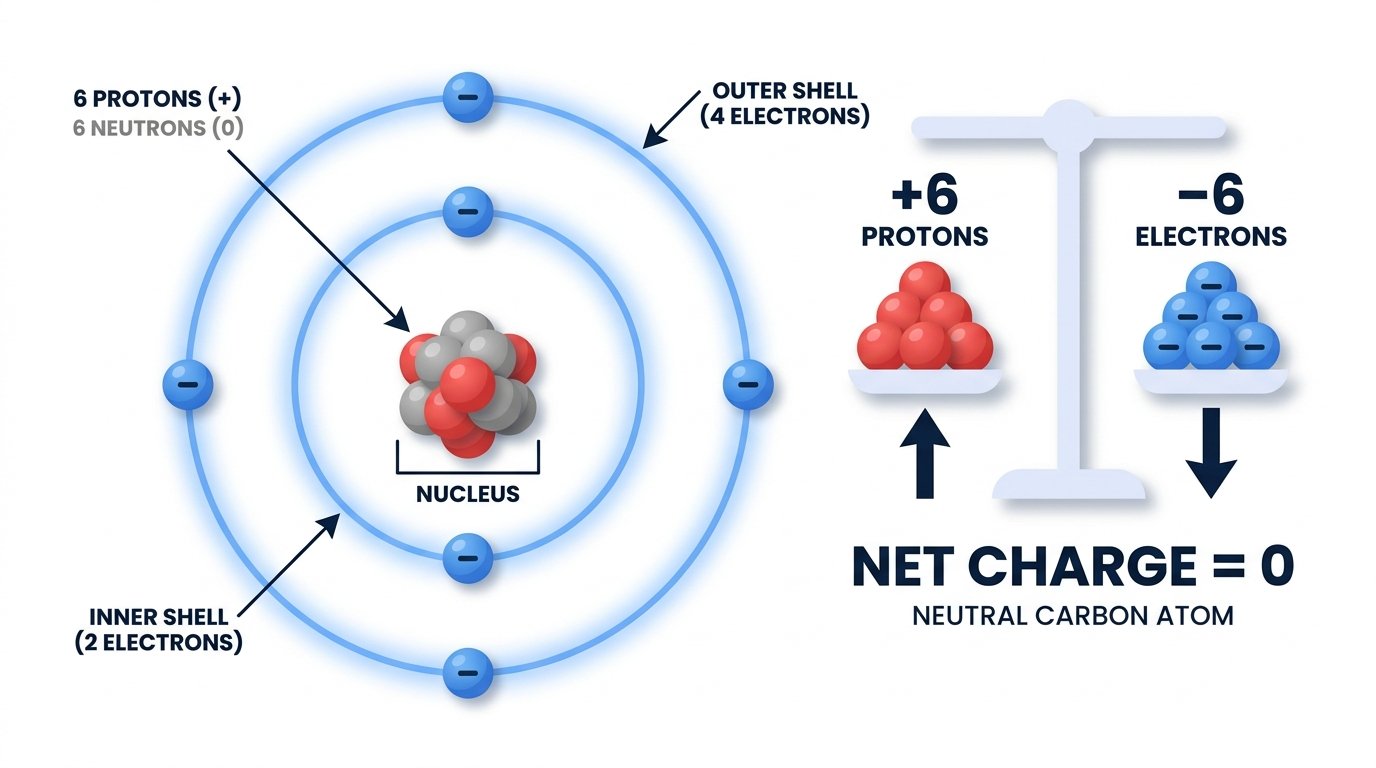
The overall charge on a neutral atom is zero. An atom contains positively charged protons and negatively charged electrons, and in a neutral atom these two particles are present in equal numbers. Their opposite charges cancel each other exactly, so the atom as a whole carries no net electric charge. This is why the objects around you, from a glass of water to a piece of iron, are normally neutral even though they are built from charged particles.
That short answer is correct, but it leaves many natural questions open. Why do the numbers match so perfectly? What happens when an atom gains or loses an electron? How is the charge of an atom different from the charge of its nucleus? The rest of this article walks through each of these questions in plain language so you can understand the idea and not just memorize it.
The Three Particles Inside an Atom
Every atom is made of three basic building blocks: protons, neutrons, and electrons. Protons and neutrons sit together in a tiny, dense center called the nucleus, while electrons move around the nucleus in regions often described as shells or orbitals. Each of these particles has its own electric charge, and this is what decides the overall charge of the atom.
A proton carries a positive charge of +1 in the units chemists use, which equals about 1.602 × 10⁻¹⁹ coulombs. An electron carries a negative charge of exactly the same size, written as −1. A neutron has no electric charge at all, which is why it is called neutral. Because the size of the proton’s charge and the electron’s charge is identical, one proton and one electron together add up to zero.
Although protons and electrons carry equal and opposite charges, they are very different in mass. A proton is roughly 1,836 times heavier than an electron, yet this large difference in mass does not affect charge in any way. Charge and mass are separate properties, so a tiny electron can perfectly balance the charge of a much heavier proton.
Why a Neutral Atom Has No Net Charge
The number of protons in an atom’s nucleus is called its atomic number, and it defines which element the atom belongs to. Every hydrogen atom has one proton, every carbon atom has six, and every oxygen atom has eight. In a neutral atom, the number of electrons equals the number of protons, so the total positive charge and the total negative charge are exactly equal.
Take carbon as an example. A neutral carbon atom has six protons, giving a total positive charge of +6, and six electrons, giving a total negative charge of −6. When you add +6 and −6 together, the result is zero. The same simple arithmetic works for every element in the periodic table, from hydrogen at the start to the heaviest elements at the end.
The reason atoms settle into this balanced state comes down to electric attraction. The positively charged nucleus pulls on negatively charged electrons, and an atom that has fewer electrons than protons will tend to attract more electrons if they are available. Meanwhile, electrons repel one another, which limits how many can crowd around a nucleus. The neutral arrangement is the natural, stable middle ground for most atoms in everyday conditions.
Do Neutrons Change the Charge of an Atom?
Neutrons do not change the charge of an atom, because they have no charge to contribute. Atoms of the same element can have different numbers of neutrons, and these versions are called isotopes. Carbon-12 and carbon-14, for example, both have six protons but differ in their neutron counts, and both are neutral when they have six electrons.
Adding or removing neutrons changes the mass of the atom and can affect how stable its nucleus is, which is why some isotopes are radioactive. However, it has no influence on the overall electric charge. Only a change in the number of protons or electrons can alter the charge, and a change in protons would turn the atom into a different element altogether.
What Happens When an Atom Gains or Loses Electrons?
An atom can become electrically charged when it gains or loses electrons. Once this happens, the numbers of protons and electrons no longer match, and the atom is called an ion. The number of protons stays fixed because it is locked inside the nucleus, so it is the electrons that move.
If an atom loses one or more electrons, it ends up with more protons than electrons and becomes positively charged. This kind of ion is called a cation. A sodium atom, for instance, has 11 protons and 11 electrons, but when it gives away one electron it has 11 protons and only 10 electrons, giving it an overall charge of +1. We write this ion as Na⁺.
If an atom gains one or more electrons, it has more electrons than protons and becomes negatively charged. This kind of ion is called an anion. A chlorine atom has 17 protons and 17 electrons, and when it picks up one extra electron it has 18 electrons, giving it a charge of −1, written as Cl⁻. Sodium and chloride ions attract each other because of their opposite charges, and this attraction is what holds table salt together.
The size of the charge depends on how many electrons are lost or gained. A magnesium atom that loses two electrons becomes Mg²⁺, while an oxygen atom that gains two electrons becomes O²⁻. In every case, you can find the charge by subtracting the number of electrons from the number of protons.
How to Calculate the Charge of Any Atom or Ion
Finding the overall charge is a simple two-step process. First, count the protons, which you can read directly from the atomic number on the periodic table. Second, count the electrons, and then subtract the electron count from the proton count to get the net charge.
Consider an atom with 8 protons and 10 electrons. The calculation is 8 − 10, which equals −2, so this particle is an ion with a charge of 2−. Now consider a particle with 13 protons and 10 electrons. The calculation is 13 − 10, which equals +3, so it is an Al³⁺ ion. When the protons and electrons are equal, the answer is zero and the particle is a neutral atom.
Overall Charge vs. Nuclear Charge
Many students mix up the overall charge of an atom with the charge of its nucleus, but these are two different ideas. The nuclear charge is the total positive charge of the protons in the nucleus, and it always equals the atomic number. For a neutral sodium atom, the nuclear charge is +11, while the overall charge of the whole atom is zero.
This difference matters because the nucleus alone is always positive, since it contains only protons and neutrons. The electrons surrounding it are what bring the total back to zero in a neutral atom. When a question asks about the “overall” or “net” charge, it is asking about the whole atom, including its electrons, and not just the nucleus.
Why Everyday Objects Can Still Become Charged
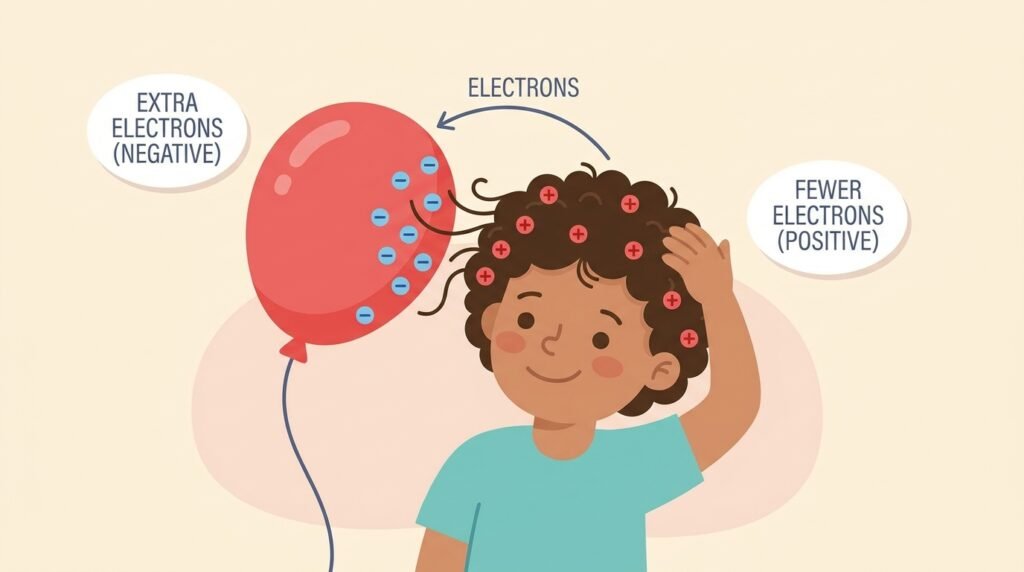
If atoms are neutral, you may wonder why you sometimes get a small shock from a doorknob or see your hair stand up after removing a hat. This happens because electrons can move between materials when they rub against each other. The atoms themselves are still built the same way, but one surface ends up with extra electrons and the other ends up with fewer.
Rubbing a balloon on your hair transfers electrons from one material to the other, leaving the balloon slightly negative and your hair slightly positive. Since opposite charges attract, the balloon can then stick to a wall or pull at your hair. This is static electricity, and it shows that a very small imbalance in electrons is enough to produce visible effects, even though only a tiny fraction of the atoms involved are affected.
A Deeper Look: Quarks and the Precision of Neutrality
Protons and neutrons are not the smallest particles. Each is made of three quarks, which carry fractional charges. A proton contains two up quarks, each with a charge of +2/3, and one down quark with a charge of −1/3, which adds up to +1. A neutron contains one up quark and two down quarks, which adds up to zero.
It is remarkable that the total charge of a proton and the charge of an electron match so precisely, because they are very different kinds of particles. Experiments have tested this balance to an extraordinary degree of accuracy and have found no measurable difference between the two. Scientists still do not have a fully settled explanation for why the match is so exact, although it is a foundational feature of the physical world as we observe it.
Common Misconceptions
One common misunderstanding is that an atom is neutral because it has no charged particles inside. In reality, an atom is full of charged particles, and it is neutral only because the positive and negative charges are equal in number. Another frequent mistake is thinking that a neutral atom has the same number of protons and neutrons, when the true rule is that protons and electrons are equal.
Some learners also believe that atoms with a charge are no longer the same element. Losing or gaining electrons does not change the element, because the identity of an element is set by its protons. A sodium ion is still sodium, and a chloride ion is still chlorine, just with a different number of electrons.
Quick Summary
A neutral atom has an overall charge of zero because its protons and electrons are equal in number and opposite in charge. Neutrons carry no charge and do not affect the total. When an atom loses electrons it becomes a positive ion, and when it gains electrons it becomes a negative ion. To find the charge of any atom or ion, subtract the number of electrons from the number of protons.
Frequently Asked Questions
Is the overall charge on an atom positive or negative?
Neither, because a neutral atom has an overall charge of zero. It only becomes positive or negative when it turns into an ion.
Why is an atom neutral?
An atom is neutral because it has the same number of positively charged protons and negatively charged electrons, and their charges cancel out.
What is the overall charge of the nucleus?
The nucleus is always positively charged, and its charge equals the number of protons it contains.
Can an atom have a charge?
Yes, an atom with a charge is called an ion, and it forms when the atom gains or loses electrons.
What is the charge of an atom with more electrons than protons?
It has a negative charge, and it is called an anion.
Disclaimer
This article is intended for general educational purposes only and does not replace professional academic instruction, textbooks, or advice from a qualified teacher or scientist. While care has been taken to keep the information accurate, scientific understanding can be refined over time, so please confirm details with your official course materials when preparing for exams or research.