
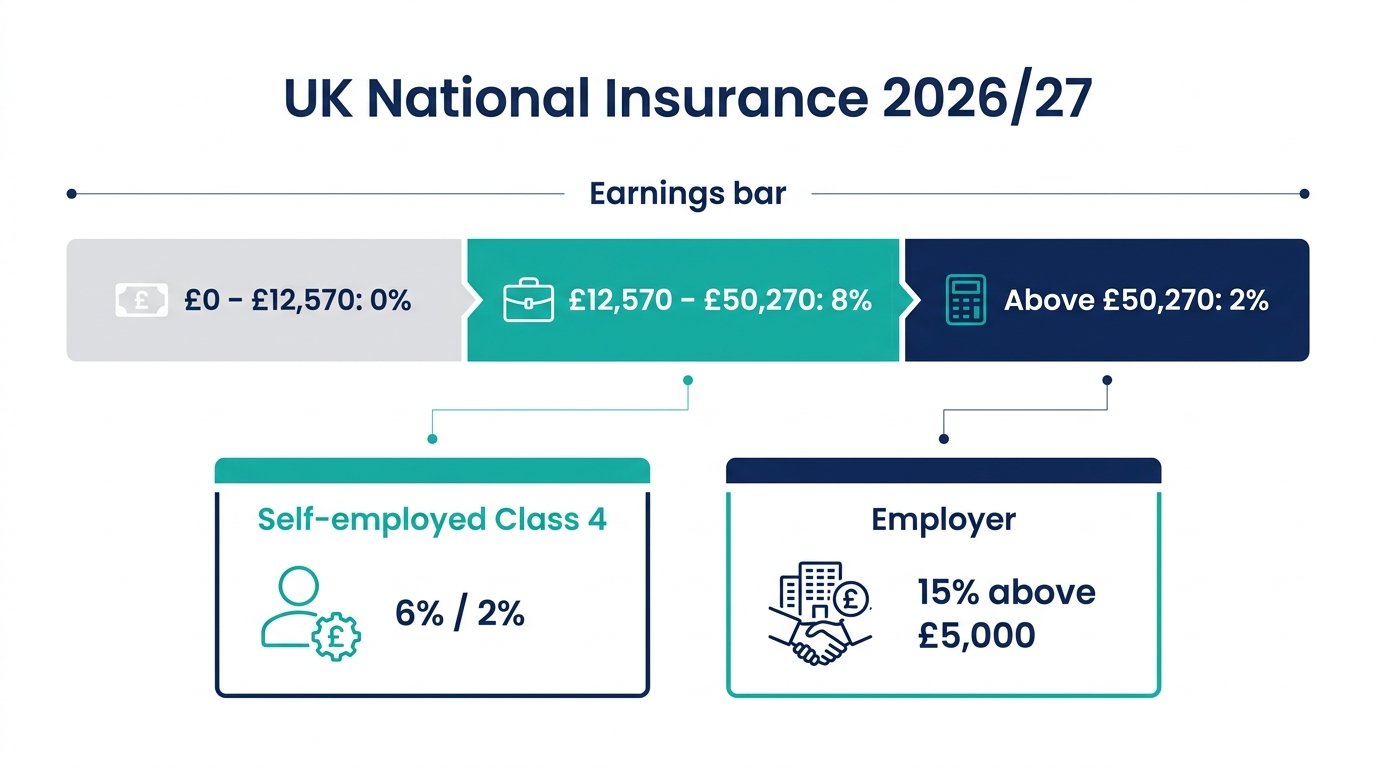
If you work in the UK, National Insurance is one of the deductions you will see on your payslip or tax return, yet it is one of the least understood. Most employees pay 8% of their earnings between £12,570 and £50,270 a year, and 2% on anything above that. The self-employed pay on a similar basis but at a lower rate of 6%. The exact amount depends on how much you earn, how you earn it, your age, and which National Insurance category you fall into. This guide explains each of these points in plain English, with worked examples so you can see what the figures mean in real money.
What is National Insurance?
National Insurance is a contribution system that runs alongside Income Tax. It helps to pay for the State Pension and other contributory benefits, and it also supports public services such as the NHS. Unlike Income Tax, National Insurance is not reduced by your personal allowance, and it is worked out separately from your tax. It is charged on earnings from employment and on profits from self-employment, but not on investment income, savings interest, dividends or rental income.
Payments also build up your record for certain benefits. Each tax year in which you pay enough National Insurance, or are treated as having paid it, can count as a “qualifying year” towards your State Pension. This is why it is worth understanding how the system treats low earners, because you can sometimes protect your pension rights without paying anything at all.
National Insurance rates for employees in 2026/27
Employees pay what is called Class 1 National Insurance, and the amount is taken from your pay automatically by your employer through PAYE. For most people, who are in category A, the rates for 2026/27 are as follows.
| Your earnings | Weekly | Monthly | Yearly | Rate you pay |
|---|---|---|---|---|
| Up to the Primary Threshold | Up to £242 | Up to £1,048 | Up to £12,570 | 0% |
| Between the Primary Threshold and Upper Earnings Limit | £242 to £967 | £1,048 to £4,189 | £12,570 to £50,270 | 8% |
| Above the Upper Earnings Limit | Over £967 | Over £4,189 | Over £50,270 | 2% |
The important point is that these rates apply only to the slice of pay that falls inside each band, not to your whole salary. If you earn £30,000 a year, you pay nothing on the first £12,570 and 8% on the remaining £17,430. You never pay 8% on the full £30,000, and moving into a higher band never reduces your take-home pay because only the extra earnings are charged at the higher rate.
There is also a lower threshold called the Lower Earnings Limit, which is £129 a week, £559 a month or £6,708 a year for 2026/27. If you earn between this limit and the Primary Threshold, you pay no National Insurance but you are still treated as if you had paid it, so the year counts towards your State Pension. Earnings below the Lower Earnings Limit do not count, unless you receive credits or make voluntary payments.
How your pay period affects what you pay
Employee National Insurance is usually calculated for each pay period rather than across the whole year. If you are paid monthly, your employer applies the monthly thresholds, and if you are paid weekly, the weekly ones apply. In practice this means that if your earnings vary from month to month, you can pay National Insurance in a busy month and nothing in a quiet one, even when your yearly total would have fallen below £12,570. This is different from Income Tax, which is usually adjusted over the year through your tax code.
Company directors are treated differently. They normally pay National Insurance on an annual basis rather than period by period, which stops the timing of salary payments from being used to reduce contributions. If you are a director, your payroll software or accountant will apply the annual thresholds for you.
Worked examples for employees
Seeing the maths can make the system much easier to follow, so here are a few examples using the 2026/27 rates.
Someone earning £20,000 a year pays 8% on the amount above £12,570, which is £7,430. That comes to £594.40 for the year, or roughly £49.53 a month. A person on £30,000 pays 8% on £17,430, which is £1,394.40 a year or about £116.20 a month.
Someone on exactly £50,270 pays 8% on £37,700, giving £3,016 for the year. A higher earner on £60,000 pays that same £3,016 on the main band, plus 2% on the £9,730 above the upper limit, which adds £194.60. Their total is therefore £3,210.60 for the year. Notice how little the extra £9,730 of earnings adds to the bill, which shows how much lower the 2% rate is compared with the main rate.
What employers pay on top of your National Insurance
Your employer pays its own National Insurance on your earnings, and this is not taken from your wages. From April 2025 the employer rate is 15% on earnings above the Secondary Threshold of £5,000 a year, which is £96 a week or £417 a month. Unlike the employee rate, there is no upper limit, so the 15% applies to all earnings above that threshold. On a £30,000 salary, for example, the employer pays 15% on £25,000, which is £3,750 a year. Many small businesses can reduce their bill through the Employment Allowance, which is worth up to £10,500 in 2026/27.
Employers also pay a separate charge, known as Class 1A, on most taxable benefits provided to staff, such as company cars and private medical insurance. Again, this is a cost to the business rather than a deduction from your pay.
How much National Insurance do the self-employed pay?
If you are self-employed, you do not pay Class 1 contributions. Instead, you pay Class 4 National Insurance on your annual taxable profits through Self Assessment, and the rates for 2026/27 are 6% on profits between £12,570 and £50,270, and 2% on profits above £50,270.
As an example, someone with profits of £40,000 pays 6% on £27,430, which comes to £1,645.80. Someone with profits of £60,000 pays 6% on £37,700, which is £2,262, plus 2% on £9,730, which is £194.60, giving a total of £2,456.60. These are calculated on your profit after allowable business expenses, not on your total income from sales.
You may have heard about Class 2 contributions, and the rules here changed in April 2024. Self-employed people are no longer required to pay Class 2. If your profits are at or above the Small Profits Threshold, which is £7,105 for 2026/27, you are automatically treated as having paid it, and your year counts towards your State Pension. If your profits are below that level, you can choose to pay Class 2 voluntarily at £3.65 a week to protect your entitlement, which is often very good value for those who want to keep building their record.
What about other classes of National Insurance?
There are five classes in total, and the last one to mention is Class 3, which is entirely voluntary. It is designed for people who have gaps in their record, perhaps because they lived abroad, took time out of work, or had low earnings, and who want to fill those gaps to protect their State Pension. The weekly rate is around £18, but you should confirm the exact current figure on GOV.UK before paying, and you should also check whether the gap can be filled and whether it is worth doing, since credits may already cover some years.
Do I still pay National Insurance if I have more than one job?
Yes, and the thresholds are applied separately to each job. If you have two jobs paying £10,000 each, you will pay no employee National Insurance on either, even though your combined earnings are £20,000. This is quite different from Income Tax, where your income is added together. If you have a job and also run a business on the side, you pay Class 1 through your employer and Class 4 on your self-employed profits. If you pay too much because of the combination, the excess can sometimes be refunded or deferred, so it is worth speaking to HMRC in that situation.
Who does not have to pay National Insurance?
You do not pay National Insurance if you are under 16, and you stop paying employee contributions once you reach State Pension age, even if you carry on working. Employers still pay their share on your earnings. If you are self-employed and over State Pension age, you also stop paying Class 4 contributions. There are some other situations where reduced rates or zero rates apply. Employers pay no National Insurance on most earnings up to £50,270 for employees under 21 and apprentices under 25, though this does not change what those employees themselves pay.
What do the category letters on my payslip mean?
Your payslip should show a letter next to your National Insurance number, and this determines which rates apply to you. Most people are category A, which uses the standard rates in the table above. Category C is used for employees over State Pension age and carries no employee contribution. Category B applies to some married women and widows with a valid election, and it carries a reduced rate, though this option is no longer available to new applicants. Other letters, such as H, M, V and Z, deal with apprentices, under-21s, veterans and people who qualify for deferment. If you think you are on the wrong letter, ask your payroll department to check it, as an incorrect category could mean you pay too much or too little.
Ways to lower the National Insurance you pay
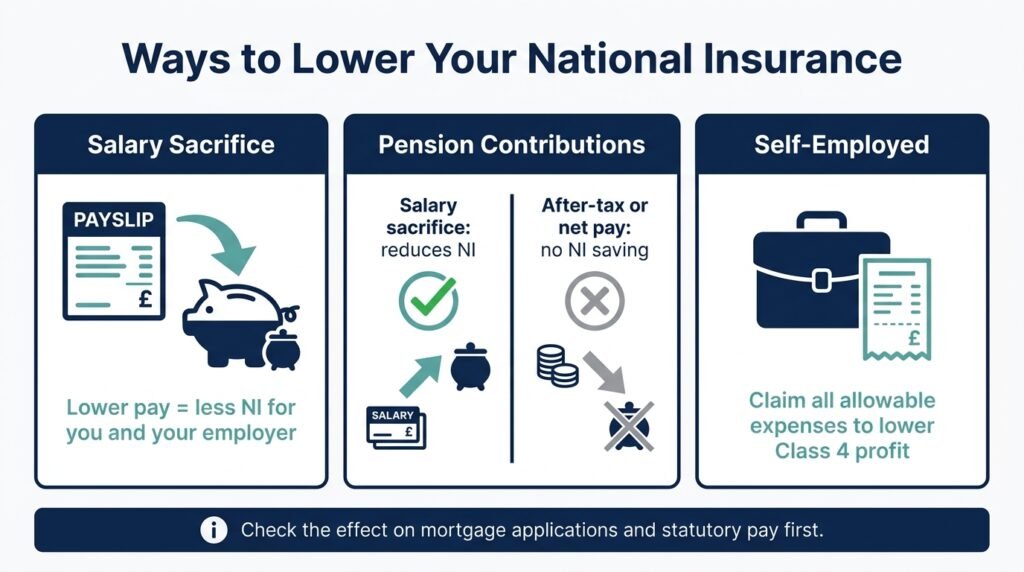
Because National Insurance is charged on your earnings, anything that legitimately reduces your earnings before the calculation can reduce your bill. One example is salary sacrifice, where you give up part of your salary in return for a benefit such as extra pension contributions. Because your pay is lower, both you and your employer pay less National Insurance, though you should check the effect on things like mortgage applications and statutory pay first. In contrast, ordinary pension contributions taken after tax, or under a net pay arrangement, do not reduce your National Insurance in the same way. Self-employed people can lower their Class 4 bill by claiming all the business expenses they are entitled to, since it is based on profit.
How National Insurance affects your State Pension
To receive the full new State Pension, which is £241.30 a week in 2026/27, you normally need 35 qualifying years on your record. You need at least 10 qualifying years to receive any new State Pension at all. Each qualifying year is worth roughly one thirty-fifth of the full amount, so a missing year can matter more than most people expect. You can check your record for free on GOV.UK, and if there are gaps, you may be able to fill them for previous years, although time limits apply.
How to check you are paying the right amount
The simplest check is to look at your payslip, which shows the National Insurance you paid in that period. You can compare this with the thresholds in this article, or use an official or reputable online calculator by entering your pay and pay frequency. If you are self-employed, your Self Assessment calculation shows your Class 4 bill before you submit. If something looks wrong, speak to your employer first, and then to HMRC if you cannot resolve it. It is worth remembering that National Insurance is the same across England, Scotland, Wales and Northern Ireland, unlike Income Tax where Scotland has its own bands.
Key points to remember
For 2026/27, most employees pay 8% between £12,570 and £50,270 and 2% above, and the self-employed pay 6% and 2% on the same bands of profit. Employers pay 15% above £5,000 on top of your wages. Thresholds are applied to each job separately and usually to each pay period, and earning above the Lower Earnings Limit can protect your State Pension even when you pay nothing. If you are unsure about your own situation, checking your payslip and your National Insurance record is the best place to start.
Disclaimer
This article is for general information only and does not constitute tax, legal or financial advice. National Insurance rates, thresholds and rules can change, and your personal circumstances may affect what you pay. Figures are based on the 2026/27 tax year and were correct at the time of writing. Always check the latest guidance on GOV.UK or speak to HMRC or a qualified adviser before making decisions based on this information.