
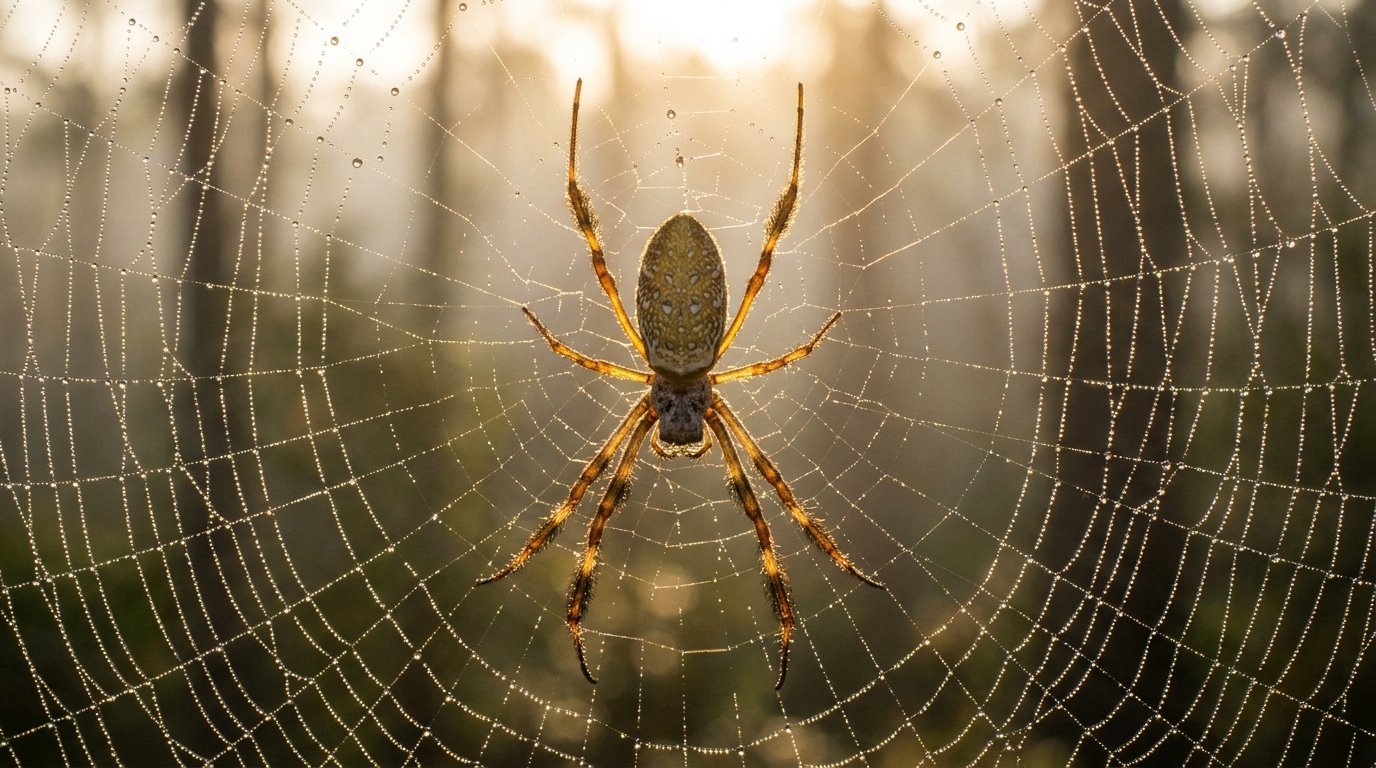
If a spider has recently crossed your path, settled in a corner of your room, or shown up in a dream, you may be wondering whether it carries a message. The spider spiritual meaning is one of the richest and most debated topics in animal symbolism, because people around the world have seen this small creature as a weaver of fate, a teacher of patience, a sign of good fortune, and sometimes a warning. In this guide you will learn what spiders have symbolised in major cultures and religions, how to read different spider encounters, what colours and types may suggest, and how to approach all of this in a grounded and honest way.
What Is the Spider Spiritual Meaning?
At its core, the spider spiritual meaning is about creation, connection, and patience. A spider builds a complex web out of its own body, and it does so slowly, carefully, and often again and again after the web is damaged. Because of this, spiders have become a symbol of creativity, of taking responsibility for your own path, and of the invisible threads that link people, events, and choices together.
Spiders also carry a second layer of meaning that is more cautious. A web can be a place of beauty and protection, but it can also be a trap, and this is why spiders have been linked to illusion, temptation, and entanglement in several traditions. The meaning you take from a spider often depends on the situation in which it appears, your cultural background, and how you feel when you see it, which is why no single interpretation fits everyone.
It is worth saying clearly that spider symbolism is interpretive. It comes from human stories, religious texts, folklore, and personal reflection rather than from scientific proof, so the most useful way to treat it is as a mirror for your own thoughts rather than a guaranteed prediction.
Why Spiders Became Such Powerful Spiritual Symbols
Spiders are among the most successful animals on Earth, with more than fifty thousand known species living on every continent except Antarctica. Every spider has eight legs and the ability to produce silk, and those two simple facts have shaped much of the symbolism built around them. Silk is remarkably strong for its weight, and many orb-weaving spiders rebuild their webs regularly, often taking in the old silk and spinning a fresh web, which people naturally connect with renewal and starting again.
The number eight adds another layer. In many belief systems the number eight is linked with balance, cycles, and infinity, because the figure 8 turned on its side becomes the infinity sign. Whether or not that connection was intended by any one culture, it is a common reason why modern spiritual writers describe the spider as a symbol of endless cycles of birth, growth, ending, and rebirth.
There is also a practical reason spiders feel so symbolic. They live quietly in the corners of our homes and gardens, they appear suddenly, and they work in a way that looks both artistic and strategic. Watching a spider build a web is a calm lesson in focus, and that quiet behaviour is exactly what many people describe when they say a spider “taught” them something.
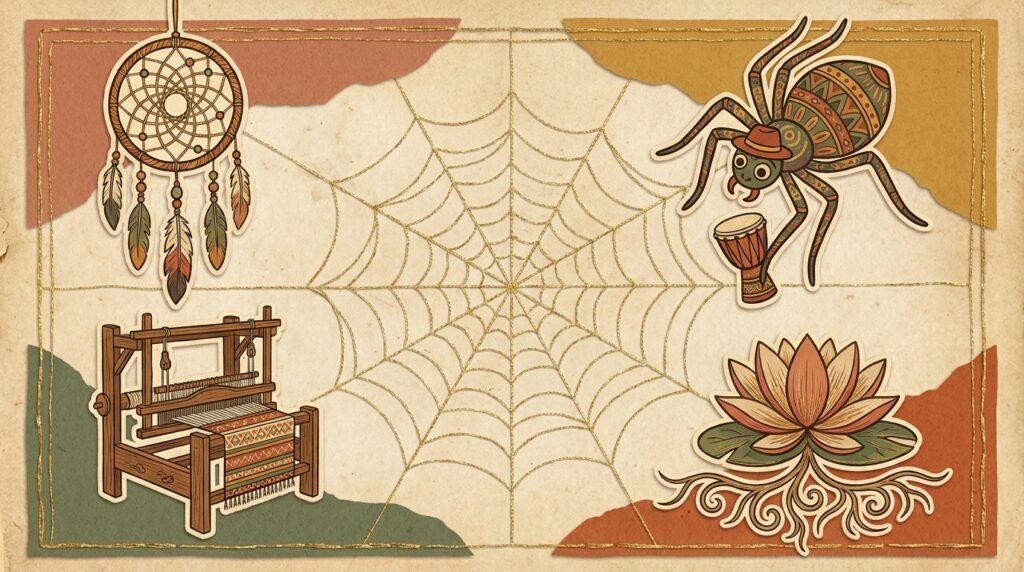
Spider Symbolism in Different Cultures and Religions
Looking at how different societies understood spiders is the best way to see why the symbol is so layered. Some cultures treated the spider as a sacred creator, others as a clever trickster, and others as a sign of weakness or deceit, so the same animal can mean very different things depending on where you look.
Spider Symbolism in Native American Traditions
In several Native American traditions the spider is connected with creation and with women’s knowledge. In Hopi tradition, Spider Grandmother, also called Spider Woman, is a helping figure who is involved in the story of how people came into the world. In Navajo tradition, Spider Woman is said to have taught people the art of weaving, and Spider Rock in Canyon de Chelly in Arizona is named in connection with her.
The Lakota tell stories of Iktomi, a spider figure who is a trickster, and his stories often teach lessons through humour, mistakes, and cleverness. The well-known dreamcatcher is linked to Ojibwe stories of Asibikaashi, a spider woman who watched over children, and the web-like design of the object reflects that protective idea.
A respectful note is useful here. These figures belong to living cultures with their own teachings, so it is better to learn from Native writers and communities than to treat them as general “spirit animal” symbols for personal use.
Spider Symbolism in West African and Caribbean Stories
Anansi the spider comes from the Akan people of Ghana and is one of the most famous characters in West African folklore. Anansi is a clever trickster who is often shown outwitting stronger animals, and in one of the best-loved stories he gains all the world’s stories from the sky god Nyame by completing a set of difficult tasks. The tales travelled to the Caribbean and the Americas through the Atlantic slave trade, where Anansi became a symbol of intelligence, survival, and resistance in the face of power.
For this reason, in these traditions the spider spiritual meaning is strongly tied to wisdom, storytelling, and using your mind to overcome a difficult situation.
Spider Symbolism in Ancient Greece
In Greek mythology, the story of Arachne is told in the Roman poet Ovid’s Metamorphoses. Arachne was a gifted weaver who boasted that her skill was greater than that of the goddess Athena, and after a weaving contest the goddess turned her into a spider who would weave forever. The word arachnid, which is used for the whole spider group, comes from her name.
This myth carries two messages at once: admiration for extraordinary skill, and a warning about pride. When people link spiders with talent and ego in the same breath, this story is often the source.
Spider Symbolism in Hinduism
In Indian philosophy, the spider and its web appear in the Upanishads as an image of how the world comes from a single source. The Mundaka Upanishad compares the way a spider sends out and draws back its thread with the way the universe comes forth from the divine and returns to it. Later writers also used the web as a picture of maya, the idea that the world of appearances can be beautiful yet also hold us in a kind of illusion until we understand its deeper nature.
Spider Symbolism in the Bible
The spider is mentioned only a few times in the Bible, and the image is mostly about fragility. In the Book of Job, the confidence of people who forget God is compared to a spider’s house, which cannot stand when leaned on. In the Book of Isaiah, weaving a spider’s web is used as a picture of empty schemes that cannot truly cover or protect a person.
This is why the biblical spider spiritual meaning is usually about false security and the weakness of trusting in things that cannot last, rather than about creativity or luck.
Spider Symbolism in Islam
The Quran has a chapter named Al-Ankabut, which means “The Spider.” In verse 41 of that chapter, those who take protectors other than God are compared to a spider building a house, and the verse says that the spider’s house is the weakest of houses. The message is that anything trusted in place of God may look like shelter but offers no real strength.
There is also a well-known story in Islamic history in which a spider wove a web across the entrance of the cave of Thawr while the Prophet Muhammad and Abu Bakr were hiding during the migration to Madinah, so that pursuers thought no one had entered. This story is widely told, although scholars of hadith differ about how strong its chains of narration are, so it is best presented as a traditional account rather than as a verified historical detail.
Spider Symbolism in China and Japan
In Chinese folk belief, a spider that lowers itself on a thread is often called a “happiness spider” and is taken as a sign of good news or joy arriving. This is one of the clearest examples of a culture seeing the spider as a positive omen.
In Japanese folklore, the picture is more mixed. The jorōgumo is a spirit said to take the form of a beautiful woman while being a spider underneath, which reflects the web as a symbol of attraction and danger together.
Spider Symbolism in Europe and Britain
In the United Kingdom and parts of Europe, there is a long folk belief in the “money spider,” a tiny spider that is said to bring money or good luck when it lands on you or your clothes. Many people there are taught not to harm it, and the belief remains common today, even though it is a piece of folklore rather than something that can be tested.
Common Spiritual Meanings of a Spider
Across all these traditions, a few themes appear again and again, and understanding them makes it much easier to interpret your own experience.
Creativity and creation. Because a spider produces its web from within itself, it is often seen as a sign to start a project, express an idea, or trust your own creative ability.
Patience and persistence. A web is built one thread at a time, and a spider will usually start again if it is torn, which is why spiders are linked with steady effort and calm resilience.
Fate and personal responsibility. The image of a weaver suggests that although life has patterns that are bigger than us, we still choose how to weave our own threads.
Connection. A web vibrates when touched anywhere, so it is a natural picture of how people, decisions, and events are linked.
Protection and good luck. In folk traditions from Britain to China to the Ojibwe, spiders are sometimes treated as guardians or as bringers of good fortune.
Warning and illusion. In religious and mythological contexts, a web can stand for a trap, a false promise, or a situation that is harder to leave than it first appeared.
What Does It Mean When You See a Spider?
When a spider appears, the most helpful approach is to look at the circumstances and at what is happening in your life right now. A spider seen while you are stuck on a decision may seem to say “slow down and plan,” while the same spider seen while you are procrastinating on a creative project may seem to say “start weaving.”
If a spider crosses your path, many modern interpretations see it as encouragement to take responsibility for a choice you have been avoiding. If a spider drops down in front of you on a thread, it may be understood as a reminder that opportunities can arrive suddenly and that you should stay alert. A spider that appears repeatedly in a short period is often read as a sign that you should pay attention to a recurring theme, such as a relationship, a project, or a worry you keep pushing aside.
It is also worth remembering the simple natural explanation. Spiders often become more visible indoors in autumn, when many males wander in search of mates, and they are also common in quiet, undisturbed rooms, so seeing one does not always mean something unusual is happening. A balanced view is to enjoy the symbolism when it helps you reflect, while keeping in mind that the spider is simply being a spider.
Spiritual Meaning of a Spider in Your House
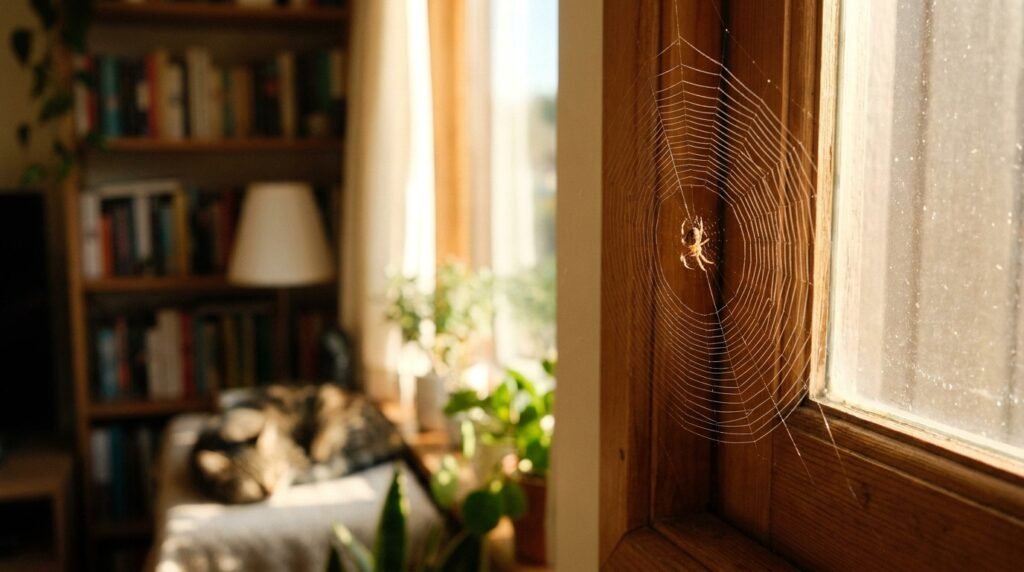
A spider living quietly in a corner of your home is often interpreted in a protective way. In many households around the world there is a tradition of leaving house spiders alone because they eat flies, mosquitoes, and other pests, and over time this practical habit became tied to the belief that a spider brings peace or luck to a home.
Some spiritual writers also say that a web in a corner reflects the “energy” of a space, suggesting it may be time to clear clutter or pay more attention to a part of your life that has been neglected. This is a personal and symbolic idea rather than a rule, and it works best as a gentle prompt to tidy your space and your thoughts.
Spiritual Meaning of a Spider on You
When a spider walks across your body, it can be startling, and many people look for meaning in the moment. In modern spiritual writing, a spider on your hand is often linked with creativity and the work you do, a spider on your shoulder with the burdens you are carrying, and a spider on your head or in your hair with thoughts, ideas, and wisdom. These are modern, symbolic readings rather than traditional teachings, so they are best used loosely.
If you feel afraid, it is perfectly reasonable to move the spider gently outside using a cup and a piece of paper, and there is no spiritual need to stay still or to feel guilty about your reaction.
Spiritual Meaning of Spiders by Colour and Type
Modern writers often give different meanings to spiders depending on their colour or type. These associations are not ancient rules, but they are popular and can be a useful way to think about what you saw.
A black spider is usually linked with protection, mystery, and the unseen parts of life, and it is sometimes connected with transformation because of the colour’s link with endings and new beginnings. A white spider is often described as a symbol of purity, clarity, and healing, partly because white is widely associated with light and calm. A red spider is said to represent passion, strong emotions, or energy that needs a direction, while a brown spider is often tied to grounding, stability, and practical effort. A yellow or golden spider, such as a golden orb-weaver, is commonly connected with abundance and confidence, and a green spider is sometimes seen as a sign of growth or healing.
Different types are also given different meanings. The jumping spider is often seen as a symbol of boldness and seizing the moment, because it hunts by leaping instead of waiting in a web. The wolf spider, which also hunts without a web, is linked with independence and instinct, and the orb-weaver, with its round and elegant web, is the classic symbol of creativity and patient design. The black widow is usually associated with powerful feminine energy and with the cycle of creation and ending, but it is also a venomous spider, so its symbolism should never encourage anyone to handle it.
Spider Spiritual Meaning in Dreams
Dreams about spiders are very common, and their meaning depends heavily on how you feel in the dream. Many dream writers say that a spider spinning a web points to a project or plan that is taking shape, while a spider chasing you may reflect a fear or responsibility you feel you cannot escape. A large spider is often read as a sign of something big that you are avoiding, and many small spiders can suggest a number of minor worries building up at once.
A dream spider that bites you is commonly interpreted as a sign of feeling drained or manipulated in a relationship, and a dream where you calmly watch a spider is often seen as a sign of acceptance and inner balance. Psychologists generally treat dream meaning as personal and symbolic, and there is no scientific evidence that a dream spider predicts the future. The most useful question to ask yourself is what the spider made you feel, and where in your waking life that same feeling appears.
Spider as a Spirit Animal or Totem
In modern spirituality, people who feel drawn to spiders often describe the spider as a spirit animal or totem. This is usually understood to mean that the person identifies with qualities such as patience, strategic thinking, creativity, and an ability to work quietly towards a long-term goal. People who feel this connection are often described as thoughtful planners who prefer to build something lasting rather than rush.
The same writers usually add a challenge to balance the strengths. A person with strong spider energy may need to avoid overthinking, controlling situations too tightly, or getting caught in their own webs of worry, and they are encouraged to practise trust and to share their work with others.
Because the phrase “spirit animal” comes from Indigenous traditions and is often criticised when used casually, some people prefer to say “animal symbol” or “personal symbol,” and that choice is worth considering if you want to be respectful.
Is a Spider a Good or Bad Omen?
The honest answer is that it depends on the culture and on the person. In Britain the money spider is lucky, in China a descending spider brings happiness, and in many homes a spider is simply welcomed as a helper. In the Bible and the Quran the spider’s web is a symbol of weakness, and in some folktales a large or aggressive spider is a sign of danger or deceit.
A helpful way to decide is to notice your own reaction and the context. If the encounter gave you a sense of calm, curiosity, or inspiration, you may choose to read it as encouraging. If it made you uneasy, you might treat it as a gentle reminder to look at something in your life that feels unresolved, without assuming that anything bad is coming.
How to Reflect on a Spider Encounter
You do not need any special ritual to learn something from a spider encounter. A simple approach is to take a quiet moment and ask yourself what you were thinking about just before you noticed the spider, because the answer often points to the theme that matters most to you right now. Writing down your thoughts in a journal can help you spot patterns over time, and you may find that the “message” is really a thought you already had but had not fully admitted.
You can also use the spider’s behaviour as a practical lesson. Choose one small project you have been delaying and work on it for ten minutes a day, as a spider adds thread after thread, or look at a situation that feels tangled and ask which single thread you can pull to loosen it. This kind of practice turns symbolism into action, which is usually where the real value lies.
Fear of Spiders and What It Can Teach
Many people feel a strong fear of spiders, and this is very common and nothing to be ashamed of. Some spiritual writers say that the fear itself can be a symbol of something in life that feels out of control, but it is equally valid to see it as an ordinary human reaction, and if the fear is intense enough to disrupt daily life, a doctor or therapist can offer effective treatments for specific phobias.
If you want to build a calmer relationship with spiders, learning a few facts can help. The great majority of spiders are harmless to people and help control insects, and only a small number have venom that is medically significant, which is why it is sensible to avoid handling unknown spiders and to seek medical advice if you are bitten and feel unwell.
Frequently Asked Questions About Spider Spiritual Meaning
What does a spider symbolise spiritually? A spider most often symbolises creativity, patience, fate, and connection, and in some traditions it also stands for protection, good luck, or a warning about illusion.
Is seeing a spider good luck? In many cultures it is, especially in Britain, where the money spider is believed to bring wealth, and in China, where a spider descending on a thread is a sign of joy, although other traditions see spiders more cautiously.
What does it mean when a spider keeps appearing? Spiritually it is often read as a prompt to notice a repeated theme in your life, but it can also have a natural cause, since spiders are common and tend to return to quiet places where they can build webs.
What is the biblical meaning of a spider? In the Bible the spider’s web usually represents fragile trust and empty plans, as shown in the Books of Job and Isaiah.
What does a spider mean in Islam? The Quran compares the house of a spider to false protection in Surah Al-Ankabut, and Islamic tradition also tells of a spider’s web at the cave of Thawr during the Prophet’s migration.
Is a spider a spirit animal? Some people feel the spider is their personal symbol because of its patience and creativity, but the term “spirit animal” has Indigenous roots, so many prefer to use a more neutral phrase.
What does a spider in a dream mean? It depends on the feelings in the dream, but common readings include creativity and planning when the spider is weaving, and stress or feeling trapped when the spider is threatening.
Should I kill a spider if I see one? There is no spiritual rule that says you must, and many people prefer to release spiders outdoors because they are useful predators of insects, while dangerous species should be dealt with carefully or by a professional.
Final Thoughts on the Spider Spiritual Meaning
The spider spiritual meaning is a rich mix of creation, patience, fate, protection, and caution, drawn from cultures and religions on every continent. Whether you see the spider as Anansi the clever storyteller, as Spider Grandmother the creator, as a weak house in the Quran and the Bible, or simply as a quiet neighbour in the corner of your room, the common thread is that it invites you to slow down and think about what you are building.
The most meaningful interpretation is the one that helps you act with more care, more patience, and more honesty in your own life. Treat the symbolism as a thoughtful companion rather than a rule, and let the humble spider remind you that even the strongest webs are made one small thread at a time.
Disclaimer
This article is provided for general information and cultural education only. The spiritual meanings of spiders described here come from folklore, religious texts, traditions, and modern symbolic interpretation, and they are not scientific facts or guaranteed predictions. Beliefs differ between cultures, faiths, and individuals, so please follow the teachings of your own tradition and your own judgement. Nothing in this article is medical, psychological, legal, or financial advice. If you are bitten by a spider and feel unwell, or if a fear of spiders affects your daily life, please contact a qualified healthcare professional. Never handle unknown or venomous spiders.