

Almost every business reaches a moment when good ideas need money to become real. You may have a product that customers like, a team ready to grow, or a new market you want to enter, but your bank balance is not big enough to carry you there. This is where growth navigate funding comes in. The phrase is used in several ways online, and that can be confusing, so this guide explains what it means, how the process works, and how to make smart decisions before you accept any money or hire any help.
What Does Growth Navigate Funding Mean?
If you search for this phrase, you will find two different meanings mixed together. The first is a general idea: growth navigate funding is the practice of planning, finding, and using capital in a way that fits your business stage. Under this meaning, you are not chasing money in a panic. You are choosing the type, amount, and timing of funding based on what your company actually needs to achieve next.
The second meaning connects the phrase to a business advisory brand called Growth Navigate, which presents services such as fundraising strategy, pitch deck preparation, financial planning, and investor introductions. In this case, the brand works as a guide or consultant rather than as a bank.
Some websites go further and describe growth navigate funding as a grant program that gives free money to businesses. Public information does not clearly confirm a single official grant program with fixed rules under this name, so you should treat those claims carefully. The safest way to think about the topic is that growth navigate funding is not one fixed financial product. It is a process and, in some cases, a service that helps you reach real funding sources.
Why Funding Strategy Matters More Than Funding Amount
Many founders believe that a bigger check always means a better outcome. In reality, the reason you raise money and the way you use it matter more than the number itself. A company that raises too little may run out of cash before it proves its idea. A company that raises too much too early may waste money, give away too much ownership, or feel pressure to grow faster than the market allows.
A good funding plan connects every dollar to a milestone. For example, you might raise money to build a working product, sign your first hundred customers, or open a second location. When each round of funding has a clear purpose, investors and lenders find it easier to trust you, and you find it easier to measure whether the money is working.
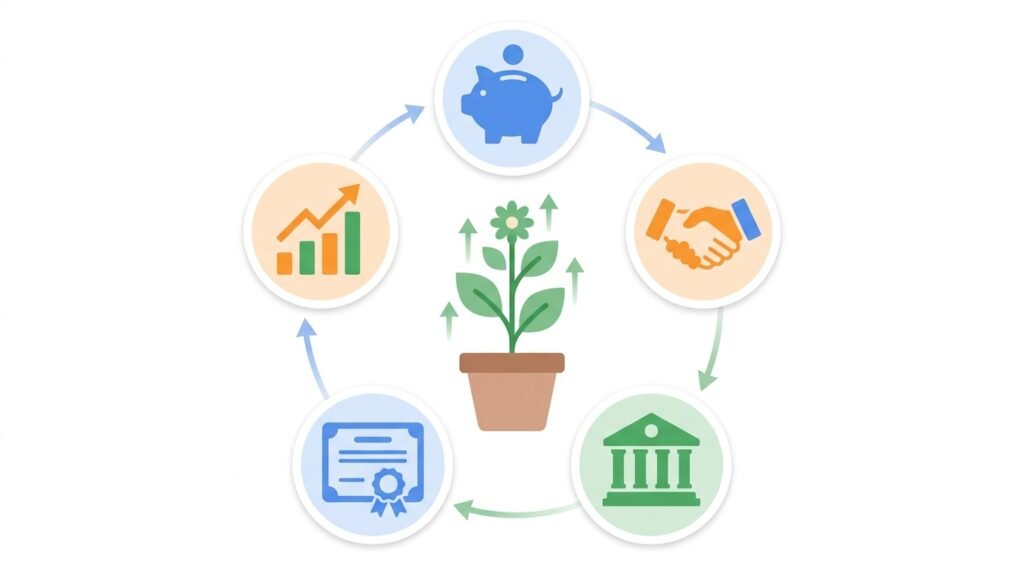
The Main Stages of Business Funding
Businesses usually move through recognizable stages, and each stage suits different types of capital.
Bootstrapping and personal funding. In the earliest days, most founders use their own savings, income from a job, or support from family and friends. This gives you full control, although growth is often slower.
Pre-seed and seed funding. At this point the money is used to build the first real version of a product and find early customers. Investors are betting mainly on the founder, the idea, and early signs of demand rather than on large revenue.
Series A and later rounds. Once a business shows steady traction, larger investors may fund expansion into new markets, bigger teams, and stronger marketing. These rounds usually require proof of repeatable revenue and a clear path to scale.
Growth capital and debt financing. Established companies with regular income can often use loans, credit lines, or growth investments to expand without selling a large share of the business.
Understanding where you sit on this ladder is the heart of growth navigate funding, because asking for the wrong kind of money at the wrong stage is one of the most common reasons founders get rejected.
Funding Options Compared in Simple Terms
Every funding type has a trade-off, and knowing them helps you choose wisely.
Equity funding means you sell a share of your company to investors such as angel investors or venture capital firms. You do not have to repay the money on a schedule, but you give up part of your ownership and often some decision-making power. Venture capital in particular suits businesses that can grow very fast and return many times the original investment, so it is not the right path for every company.
Debt funding means you borrow money and repay it with interest. Bank loans and government-backed small business loans fall into this group. You keep full ownership, but you must make regular payments even in slow months, so steady cash flow is important.
Grants are funds that do not need to be repaid and do not take ownership, which is why they are called non-dilutive. They are usually offered by governments, foundations, or industry programs for specific purposes such as research, innovation, or community impact. They are competitive, they come with rules, and they often take months to arrange.
Revenue-based financing gives you money in return for a percentage of your future income until a set amount is repaid. It can suit businesses with predictable sales that do not want to sell equity.
Convertible notes and simple agreements for future equity are common in early rounds. They let investors put money in now and receive shares later, often at a discount, which helps founders avoid setting an exact company value too early.
No option is best for everyone. A software company with fast growth may lean toward equity, while a local retailer with steady sales may find a loan cheaper and simpler.

How to Prepare Before You Ask for Money
Preparation often decides the result before the first meeting even starts. Investors and lenders read many requests, and they quickly notice which founders have done their homework.
Start with your numbers. You should know your monthly income, expenses, cash runway, and how much you truly need. Runway means the number of months your business can operate before the money runs out, and many advisors suggest raising enough to cover a comfortable period of operation rather than the bare minimum.
Next, build a simple financial forecast that shows how the funding will turn into growth. Avoid unrealistic promises, because experienced investors are used to seeing inflated projections and tend to trust careful, honest ones.
Then prepare your story. A strong pitch explains the problem you solve, who your customers are, how you earn money, what you have already achieved, and exactly what you will do with the funds. Keep your documents organized as well, including company registration papers, tax records, contracts, and your ownership table, since due diligence, the checking process that comes before a deal closes, can slow down or kill a deal when records are messy.
Where Advisors and Growth Navigate Services Can Help
Some founders work with advisory firms to prepare pitch decks, build financial models, and identify suitable investors. This support can save time, especially for first-time founders who do not know how the fundraising world works. A good advisor also helps you avoid weak deals and negotiate better terms.
However, an advisor is a guide and not a guarantee. No honest consultant can promise that you will receive funding, because the final decision always belongs to the investor or lender. Fees also vary widely, so you should ask exactly what you will pay, when you will pay it, and what happens if no funding is secured.

How to Check Whether a Funding Service Is Trustworthy
Because the funding space attracts both genuine experts and bad actors, a few careful checks can protect you. Look for a clear business identity with a real address, named team members, and a history you can confirm through independent channels such as professional networks or client references you can contact yourself.
Be careful with anyone who guarantees approval, asks for large upfront fees before doing any work, or pressures you to decide quickly. Also be cautious of offers that describe free grant money without explaining who funds it, what the rules are, and how to apply through an official channel. Real government and foundation programs publish their eligibility rules openly and do not charge you just to receive an award. When in doubt, ask for every promise in writing and have a lawyer or accountant read the agreement.
Common Mistakes to Avoid
The first mistake is raising money only when cash is almost gone. Fundraising takes time, often several months, and desperation weakens your position. Start the conversation while your business still has healthy options.
The second mistake is targeting the wrong investors. Every investor has a preferred industry, company size, and stage, and sending your request to people outside that range wastes effort.
The third mistake is ignoring dilution, which is the reduction in your ownership each time you sell shares. A small percentage given away in each round can add up to a large loss of control, so it helps to model how ownership changes across future rounds before you sign.
The fourth mistake is treating funding as the finish line. Money is a tool, and the real work starts after the deposit. Tracking spending, reporting to investors, and hitting the milestones you promised are what build the trust needed for your next round.
A Simple Step-by-Step Approach
Begin by defining your goal in one sentence, such as expanding to a new city or launching a second product. Estimate the cost, then decide which funding type fits that goal and your stage. Prepare your financials and pitch, research investors or lenders that match your profile, and approach them in an organized way. Compare offers carefully, focusing on cost, control, and flexibility rather than the headline amount alone. After funding arrives, follow a written plan and review your results every month.
Frequently Asked Questions
What is growth navigate funding? It is the practice of planning and matching the right kind of capital to your business stage, and the name is also linked to an advisory brand that offers fundraising support.
Is growth navigate funding a grant or a loan? It should not be treated as one fixed product. Any real money you receive will come from a specific source, such as an investor, a lender, or a grant body, and each has its own terms.
Can a business get funding without giving up ownership? Yes. Loans, grants, and revenue-based financing let you keep your shares, although each has other requirements or costs.
How long does raising funds usually take? It depends on the type and size of funding, but many founders should plan for several months from preparation to receiving money.
Do I need an advisor to get funding? No. Advisors can help with preparation and introductions, but you can also approach lenders, programs, and investors on your own if you are well prepared.
Final Thoughts
Growth navigate funding is best understood as a smart habit rather than a magic program. When you know your stage, choose the right type of capital, prepare honest numbers, and check every partner carefully, you give your business a far better chance of growing in a healthy way. Take your time, ask questions, and let your growth plan guide your funding choices instead of letting urgency make them for you.
Disclaimer: This article is for general information only and is not financial, legal, or investment advice. Funding rules, costs, and eligibility differ by country, program, and provider, and they can change over time. Please confirm all details with official sources and consult a qualified financial or legal professional before making any funding decision.