
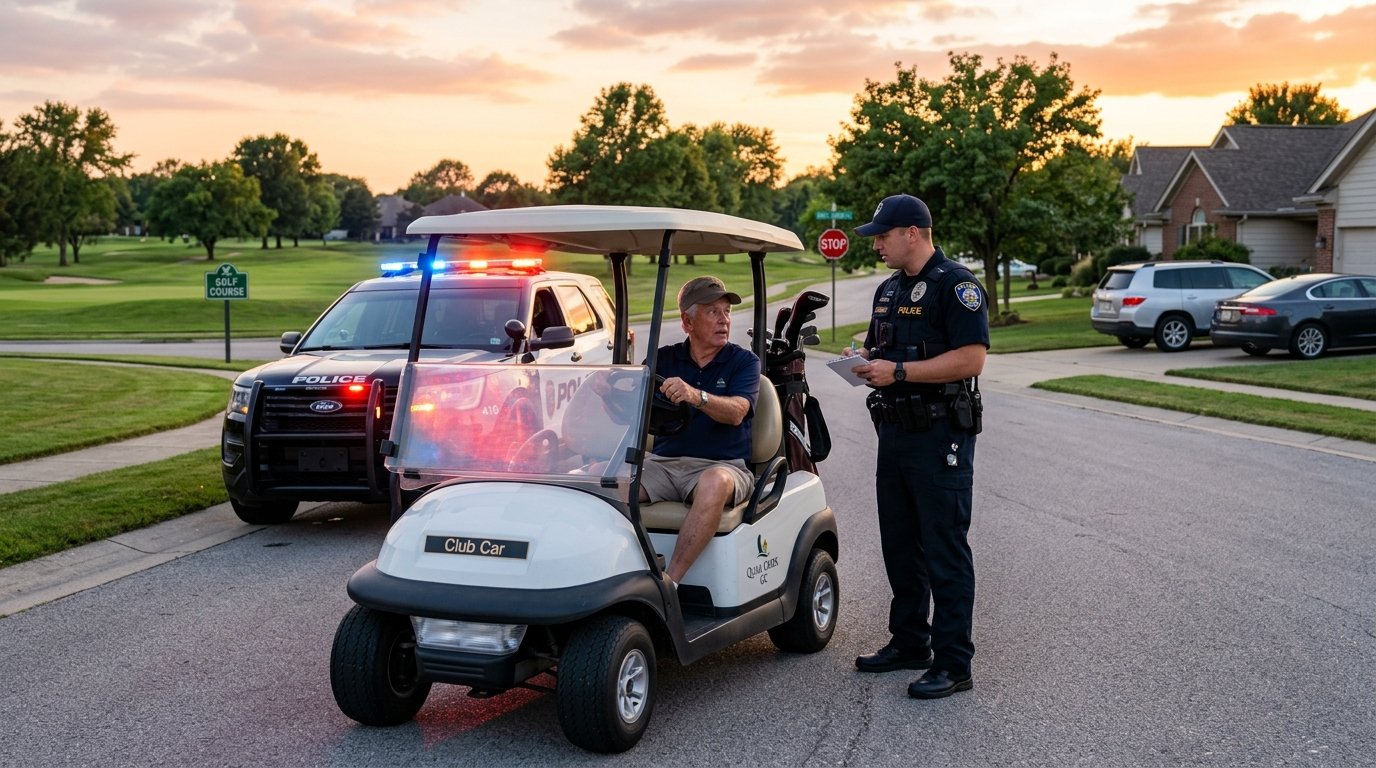
If you’ve ever wondered, “can you get a DUI on a golf cart?”, the short answer is yes. In almost every state, a golf cart counts as a motor vehicle under the law. That means the same drunk driving rules that apply to a car or truck also apply to a cart with a beer cooler strapped to the back. This surprises a lot of people, especially in places where golf carts are just how people get around.
Golf carts feel casual. They move slowly, often under 20 miles an hour. You see them gliding through retirement communities, beach towns, and golf resorts. But police and courts do not treat them as toys. Once alcohol or drugs are involved, a golf cart can lead to the same arrest, the same court date, and often the same fines as driving a sedan home from a bar. This guide breaks down why that is, what the penalties look like, and how the rules shift depending on where you live.
Why Golf Carts Count as Motor Vehicles Under DUI Law
Most state laws don’t list every type of vehicle by name. Instead, they use broad terms like “motor vehicle” or “any vehicle.” A golf cart is self-propelled and built to carry people, so it fits that definition almost everywhere. [link to related article on golf cart registration laws by state]
There’s no built-in “golf cart exception” carved into drunk driving statutes. Courts have said so directly. In Georgia, an appeals court ruled in Simmons v. State that DUI law reaches golf carts driven on cart paths, not just on public streets. Florida law spells this out even more clearly: Florida Statute 316.193 treats golf carts as motor vehicles for DUI purposes, and the state’s broader vehicle code echoes that language. Arizona goes a step further and names golf carts directly in its statutory definition of a motor vehicle.
There’s also a practical reason judges and lawmakers don’t cut golf carts any slack. A golf cart usually has no doors, no airbags, and often no seatbelts. Some safety advocates argue that a drunk driver is actually more exposed to injury in a cart than in a car, since there’s so little structure protecting the people inside. That logic shows up again and again in how these cases are prosecuted.
Can You Get a DUI on a Golf Cart on a Golf Course?
This is where things get more layered. Whether a DUI applies on the course itself often comes down to one question: is that piece of land open to the public, or is it private?
Many state DUI laws only apply to public roads and to private property that the public can freely access. A resort golf course, a public course, or a private club that regularly hosts outside guests and events usually counts as publicly accessible, even though it’s privately owned. A handful of states go further and apply DUI law everywhere within state lines, public or private, which removes the question entirely.
In practice, police rarely patrol golf courses looking for impaired cart drivers. Most golf cart DUI arrests on courses happen because something else brought police there first, such as a crash, a call about a disturbance, or a report of someone driving erratically near the clubhouse. Once officers are on scene and observe signs of impairment, the same DUI process kicks in that would apply to any other driver.

State-by-State Rules: Florida, Texas, California, Illinois, Georgia, and South Carolina
Can You Get a DUI on a Golf Cart in Florida?
Florida is the state most associated with golf cart DUIs, largely because of retirement communities like The Villages, where tens of thousands of carts serve as everyday transportation instead of cars. Florida Statute 316.193 explicitly classifies golf carts as motor vehicles, so the standard DUI process applies: a breath test, a .08% BAC threshold, and the same criminal charge a car driver would face. First-offense penalties commonly include several hundred to a couple thousand dollars in fines, up to six months in jail, license suspension of at least 180 days, and mandatory DUI school. A higher BAC or a minor passenger in the cart can push penalties even further. Florida’s implied consent law also applies, meaning refusing a breath test brings its own automatic license suspension.
Can You Get a DUI on a Golf Cart in Texas?
Texas treats a golf cart DWI the same as a car DWI under Texas Penal Code §49.04, which criminalizes operating a motor vehicle while intoxicated in a public place. Texas defines “motor vehicle” broadly enough to sweep in golf carts, and the .08% BAC limit applies equally. Golf carts often cross short stretches of public roadway to link one part of a course, neighborhood, or gated community to another, and that crossing alone can be enough to bring a cart under DWI law. The same enhanced penalties that apply to regular DWIs, including higher fines for a BAC of .15 or above, apply here too.
Can You Get a DUI on a Golf Cart in California?
California’s vehicle code defines a “vehicle” as anything that moves people or property and isn’t powered purely by a person or run on a fixed track. That sweeps in golf carts alongside bicycles and other non-traditional rides. California also uses a “volitional movement” standard, meaning the driver only has to have intentionally moved the vehicle while impaired for a DUI charge to apply, regardless of how far the cart actually traveled. First-offense penalties can include fines in the hundreds to low thousands of dollars, up to a year in jail, and a license suspension of six months to a year, though jail time is not automatic for a first offense.

Can You Get a DUI on a Golf Cart in Illinois?
Illinois DUI law, found in 625 ILCS 5/11-501, bans operating “any vehicle” while impaired, and the state’s definition of vehicle is broad enough to include golf carts used on public roadways. A related statute, 625 ILCS 5/11-1426.1, separately makes it illegal to operate a “non-highway vehicle,” a category that includes standard golf carts, on a public road while under the influence. A first offense is generally a Class A misdemeanor, but Illinois law allows a DUI to become a felony, called an Aggravated DUI, when factors like a suspended license or repeat offenses are involved. That escalation applies to golf cart cases exactly as it would to a car.
Can You Get a DUI on a Golf Cart in Georgia?
Georgia’s DUI statute, O.C.G.A. §40-6-391, applies to “any moving vehicle,” and Georgia courts have confirmed that includes golf carts on dedicated cart paths, not just public roads. This matters a great deal in places like Peachtree City, where thousands of registered golf carts share a large network of paths as a genuine transportation system. Local police there make DUI arrests on golf carts on a fairly regular basis. First-offense penalties in Georgia are notably strict, often including a mandatory minimum jail stay, community service, a full year of license suspension, and a required alcohol evaluation.
Can You Get a DUI on a Golf Cart in South Carolina?
South Carolina law defines a motor vehicle broadly enough to include golf carts, and the state’s .08% BAC threshold applies the same way it would to any car. This comes up often in coastal resort towns and gated communities where golf carts are a common way to get to dinner or the beach. Even a first offense can bring a meaningful fine and the possibility of jail time or community service, and an open container of alcohol in the cart can add a separate citation on top of the DUI itself.
What Makes a Golf Cart DUI Different From a Regular DUI
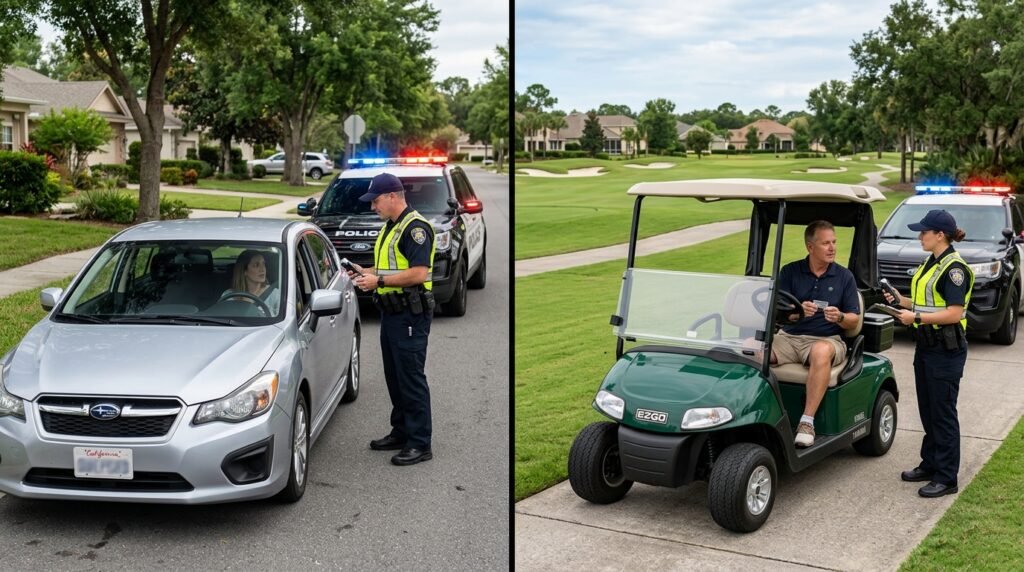
Legally, very little changes once you swap a car for a golf cart. The BAC threshold stays at .08% almost everywhere, the criminal charge is the same, and a conviction goes on your record as a standard DUI, not some lesser version of one. Sentencing enhancements for a high BAC, a minor passenger, or a repeat offense apply just as they would behind the wheel of a car.
What does change is the context that leads to the stop. Police rarely run traffic patrols looking for drunk golf cart drivers the way they might near bars on a Saturday night. Instead, most golf cart DUI cases start with something else, like a single-cart accident, a report of someone driving erratically through a neighborhood, or a call about a disturbance at a course or clubhouse. Once officers arrive and see signs of impairment, such as slurred speech, an odor of alcohol, or an open container, the process unfolds the same way it would for any other DUI stop.
Recent Developments Worth Knowing About in 2026
Golf cart use has expanded quickly in low-speed vehicle (LSV) communities across the Sun Belt, and several states have leaned into treating any motorized cart operating on a public road as a full motor vehicle for DUI purposes, regardless of whether it’s formally registered as an LSV. Once a cart is registered as an LSV, capable of 20 to 25 mph and meeting federal safety standards, DUI law applies to it without exception on public roads. This distinction mostly affects registration, insurance, and where a cart is legally allowed to drive, but for DUI purposes, the legal exposure is essentially identical whether the vehicle is a basic golf cart or a registered LSV. [link to related article on low-speed vehicle registration requirements]
Frequently Asked Questions
Can you get a DUI on a golf cart on private property?
It depends on the state and whether that property is open to the public. Many states apply DUI law to private property accessible to the public, like a resort golf course. A small number of states apply DUI law everywhere, public or private, removing this distinction entirely.
Is the BAC limit different for a golf cart than for a car?
No. The standard .08% blood alcohol concentration limit applies to golf carts in virtually every state, the same threshold used for cars, trucks, and motorcycles. A small number of states may apply a lower limit to underage drivers regardless of vehicle type.
Will a golf cart DUI show up on my driving record?
Yes. A golf cart DUI conviction is treated as a standard DUI conviction and goes on your criminal and driving record. It is not recorded as a separate or lesser offense just because the vehicle was a golf cart.
Can I get an open container ticket in a golf cart?
In most states, yes. Having an open alcoholic beverage in a golf cart on a public road is treated the same as having one in a car, and it can result in a separate citation alongside or instead of a DUI charge.
Does refusing a breath test matter in a golf cart DUI stop?
Yes. States with implied consent laws, including Florida, apply those laws to golf cart stops. Refusing a breath or blood test after a lawful arrest can trigger an automatic license suspension, separate from any DUI conviction itself.
Can a golf cart DUI become a felony?
In some states, yes. Illinois, for example, allows a DUI to be charged as a felony, called an Aggravated DUI, when aggravating factors like a suspended license or multiple prior convictions are present, and this applies to golf carts the same as cars.
Are penalties lighter for a golf cart DUI than a car DUI?
Generally, no. Courts typically apply the same sentencing range to a golf cart DUI as they would to a car DUI. The vehicle type does not usually reduce fines, jail exposure, or license suspension length in most states.
Final Thoughts
A golf cart might feel worlds away from a car, but in the eyes of the law, it usually isn’t. If you’ve had a few drinks, the safest move is the same one you’d make with any other vehicle: find another way home. Whether you’re cruising through a retirement community, crossing a cart path in Peachtree City, or heading back from the clubhouse after a round, treat that cart like you would treat your car keys.
Desclaimer:
This article is for general informational purposes only. Laws vary by state and can change over time, and this piece reflects publicly available legal information as of mid-2026. For advice on a specific charge or situation, please consult a licensed attorney in your state.